Installation of Bishop Rehberg
The word “Episcopal” refers to government by bishops.
The historic episcopate continues the work of the first apostles in the Church, guarding the faith, unity and discipline of the Church, and ordaining men and women to continue Christ’s ministry. An Episcopalian is a person who belongs to the Protestant Episcopal Church, the branch of the worldwide Anglican Communion in the United States. As Episcopalians, we believe:
- The Holy Scriptures are the revealed word of God, which inspired the human authors of the Scripture, and which is interpreted by the Church under the guidance of the Holy Spirit. (link to Bible Gateway www.biblegateway.com)
- The Nicene Creed is the basic statement of our belief about God. It was adopted in the 300s by the early church founders and is said every Sunday in Episcopal and Anglican churches around the United States and world. (//www.creeds.net/ancient/nicene.htm)
- The two great sacraments of the Gospel, given by Christ to the Church, are Baptism and the Holy Eucharist. In Baptism we renounce Satan, repent of our sins, and adopt Jesus as our Lord and Savior. In the Holy Eucharist, the center of our worship life, we remember and participate in the life, death and resurrection of Jesus Christ until his coming again.
- Catechism: (//www.bcponline.org) The teachings and beliefs of the Episcopal Church are articulated in this "Outline of the Faith." It is designed in a question and answer format.
How the Episcopal Church Differs From Other Denominations
Historically, bishops oversee the Church in particular geographic areas, known as dioceses. In the worldwide Anglican Communion, the Archbishop of Canterbury, who oversees the Diocese of Canterbury, occupies a special position by virtue of history and tradition but he does not hold a governing position. We are a confederation of equals. Bishops from the Anglican Communion meet every 10 years for the Lambeth Conference, at the invitation of the Archbishop of Canterbury, but the resolutions coming from that Conference do not hold authority over all members of the Communion. Collegiality among bishops is the substitute for authority, and communal discernment is the substitute for decision-making power.Each bishop and diocese, operating through an annual council, determine the character of life and work in that diocese within a set of general decisions made by a triennial General Convention of The Episcopal Church as a whole. These decisions are formalized as canons—rules that govern—by The Episcopal Church and subsequently by each affected diocese. Each diocese elects and sends clergy and lay representatives—deputies—to the General Convention. The annual Council of the Diocese of Spokane takes place each October. The Episcopal Church celebrates diversity. We are young and old, male and female, gay and straight, single, married, divorced and widowed, Anglo, African American, Latino, African, Asian, CEO and unemployed, student and teacher, rich and poor. We worship together, study and ask questions as we move more deeply into the mystery of God. We honor tradition and strive to live by the example of Jesus Christ, welcoming the stranger and the outcast, helping our neighbors and offering love and forgiveness. We want our communities to be better because The Episcopal Church is here.We are known for our engaging and beautiful worship services. For those who have grown up Roman Catholic, the service, known as the Mass, Eucharist or Holy Communion, will be very familiar. For those of reformed tradition or no religious tradition at all, we think you may find a spiritual home in a church that respects its tradition and maintains its sense of awe and wonder at the power and mystery of God. Some services are more contemporary, some more traditional but all follow the same form found in the Book of Common Prayer. There are no prerequisites in the Episcopal Church … Everyone is welcome. We walk the "middle way" between Protestant and catholic traditions. We often talk about the Episcopal Church as following the “via media” or middle way in our theology and discussions because we believe that, whether or not we agree on a particular topic, we all are children beloved by God and we can have thoughtful and respectful discussions. The Episcopal Church has between 2-3 million members in about 7,500 congregations in the United States, the Virgin Islands, Haiti, Europe and other areas in North America. In the Diocese of Spokane (one of two dioceses in the state of Washington and one of two diocese in the state of Idaho), we have more than 5,000 members in 38 congregations. We also have numerous social service agencies and hundreds of ministries that reach out to help make our communities better and more caring places to live. We are part of the global Anglican Communion, which has 70 million followers.
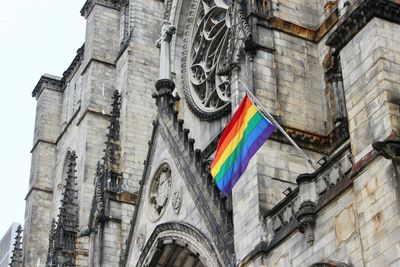
Learn more about the Episcopal Church here
The Rt. Rev. Gretchen M. Rehberg
Bishop Gretchen Rehberg, Ph.D., D.Min. was ordained and consecrated March 18, 2017 as ninth bishop of the Episcopal Diocese of Spokane.
She is passionate about proclaiming the inclusive love of God and equipping the people of God for transformation and growth. Christian formation for all ages is of vital importance to Gretchen, and she stresses the need for both rigorous engagement and the need for openness and humility in learning. She served as the Rector of the Episcopal Church of the Nativity from 2006 to 2017, after having been elected bishop in 2016.
She has served as the Chair of the Commission on Ministry, a Canon for Regional Mission, and a trainer for the College for Congregational Development. In these ministries, she combined her passion for equipping people for ministry and assisting congregations in becoming more faithful, healthy, and effective communities of faith. She has a M.Div. from General Seminary, a D. Min. from Wesley Seminary, and Ph.D. in Chemistry. Previously she was a professor of organic chemistry, and served her community as an EMT/firefighter.
Read the history of our diocese on the diocesan website.

The Presiding Bishop of The Episcopal Church
The Most Rev. Sean W. Rowe
The Most Rev. Sean W. Rowe was elected presiding bishop and primate of The Episcopal Church in June 2024 and took office on Nov. 1 for a nine-year term. In this role, he serves as the church’s chief pastor and CEO. Known for his expertise in organizational learning and adaptive change, Rowe is committed to strengthening support for local ministry and mission.
He was ordained bishop of the Episcopal Diocese of Northwestern Pennsylvania in 2007 after serving as rector of St. John’s in Franklin, Pennsylvania, for seven years. From 2014 to 2018, he served as bishop provisional of the Episcopal Diocese of Bethlehem, and from 2019 to 2024, he led a partnership between the Episcopal Dioceses of Northwestern Pennsylvania and Western New York.
Rowe holds a bachelor’s degree in history from Grove City College, a Master of Divinity degree from Virginia Theological Seminary, and a doctorate in organizational learning and leadership from Gannon University. He has served as a leader of many civic and churchwide organizations and governance bodies, and as parliamentarian for the House of Bishops.
Contact: Vanessa Butler
Executive Coordinator to the Presiding Bishop
